
When Boromir Stopped Being Fine
When survival mode finally runs out of road.

Can we talk about The Lord of the Rings? This won’t be the last time either. I come back to this series again and again. I watch these movies (extended versions of course!) at least once a year. It doesn’t take much to lure me in. A quote, a picture, a song. I am not sure what prompted it this time around, but last weekend, I couldn’t get Boromir out of my mind. Then on Sunday, I heard a song (which I will reveal in Friday’s Stillness in the Sound) and I imagined this was Boromir’s heart at the end of The Fellowship of the Ring.
If anyone lived under the mask of fine, it’s Boromir. He is the oldest son of Denethor II, who was the Steward of Gondor. He was beloved by his father and his troops. He was looked to for strength. The weight of a dying kingdom was sitting on his shoulders. To all who saw him, he was fine. Because he HAD to be. This weight was so heavy, he couldn’t be anything else.
Under this pressure, wanting to save Gondor, Boromir was misguided. He saw Frodo with the ring, and he allowed his fear of losing his kingdom and disappointing everyone guide his steps. In his pain and understanding of his true purpose, he didn’t think destroying the ring was the way to freedom. He wanted to force the right ending. He looked down on Frodo and his desire to destroy the ring. When he does try to forcefully take the ring from Frodo, he doesn’t sit and wallow in his inability to get it. His motives, while somewhat outward as he sought to save Gondor, were selfish. They were rooted in pride and in his desire to perform well, to be good enough to earn the title he held. He fell into the same trap we are often seduced into. The enemy is crafty. He is shrewd. He uses the good things in our lives to tempt us, but he lulls us in by assuring us it is for the good of others. Satan knows the language of God. He knows intimately what it is like when you allow your own desires to overtake the truth. And it is in these quiet places that he sows his lies. He tells us we have to be strong, we have to wear a mask that says to the world we are invincible, that nothing can hurt us. And when we believe these lies, we begin to look to our own selves to save us. We forget our true purpose, to be good stewards of the name and title we bear.
Boromir is often seen with hatred. That’s how I viewed him for so long. Until I saw myself in Boromir. I saw how easily I try to reach for the ring, to seize what God is asking me to patiently wait for him to reveal. I grab at whatever is in reach, trying to manipulate the victory. That is where Boromir found himself.
Boromir could have gone off and pouted. He could have made excuses, minimized the harm he had caused by trying to steal Frodo’s purpose and calling, or basked in his own righteousness. But that isn’t what he did. He immediately realized what he had done.
In that moment, Boromir had his very own road to Damascus experience. Instead of giving in to the lie that he had to do that, for himself and for the kingdom, he grieved.
Deeply.
Merry and Pippin were in grave danger. Boromir saw this, and he saw his own weakness and pride. In that moment, as he realized he became someone he never wanted to be, a new purpose rose up within him. He laid down his title. He laid down all the things that had been placed on him throughout his lineage. He set down his rightful place as the future steward of Gondor and he ran into the fight.
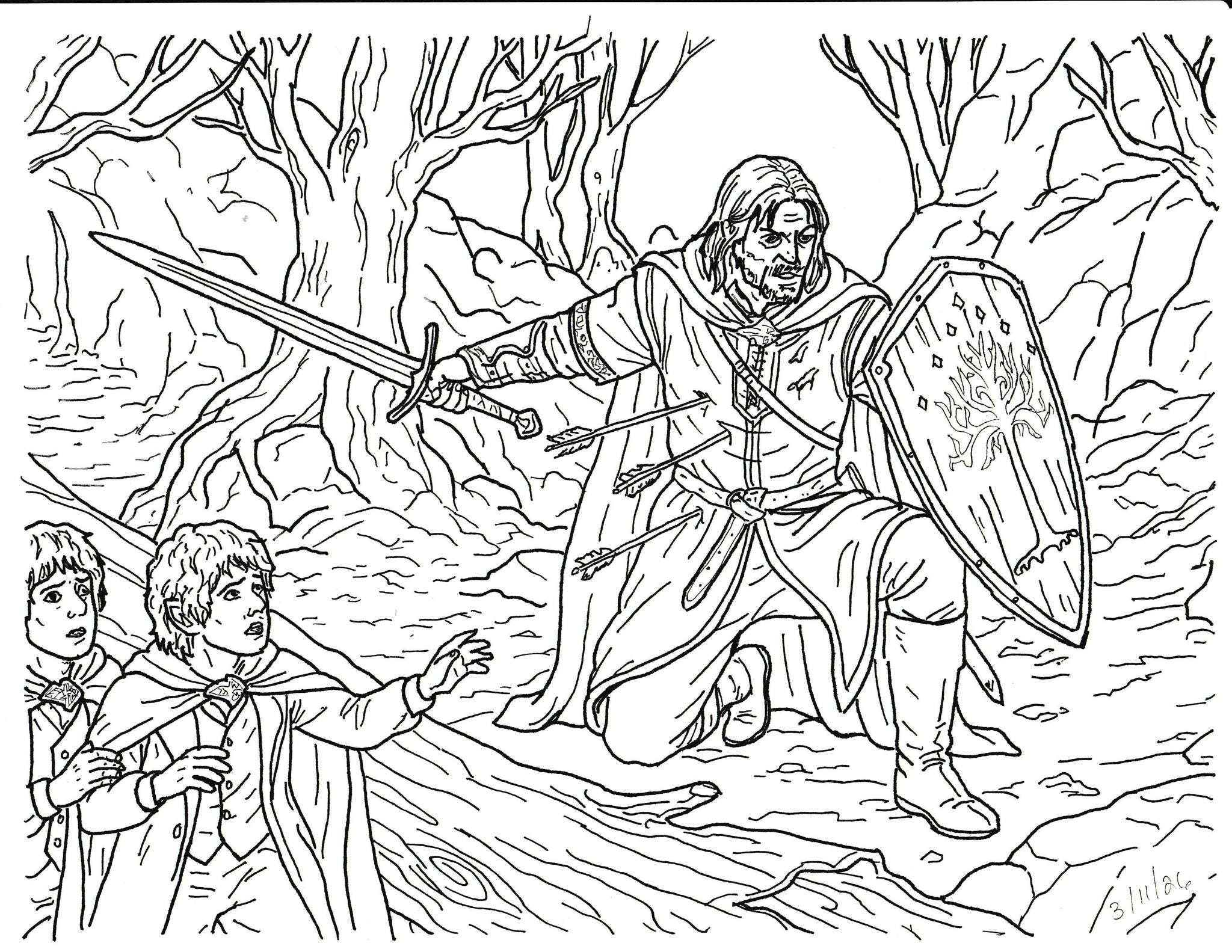
He stood up, he shook off the shame and the years of striving to be good enough, and he stepped into a battle that he didn’t start. And it is in this moment that he fought to save Merry and Pippin. He ran into a swarm of enemies, and he put distance between the Orcs and the hobbits. He took arrow after arrow, using his very last drop of strength to protect them. And when he lay there dying, as Aragorn held him in his arms, he didn’t make excuses. He didn’t defend himself. He didn’t even tell Aragorn how heroic he had been at the end. Instead, he confessed. His voice broke as he told Aragorn he had tried to take the ring from Frodo. The scenes with Boromir are short. He doesn’t come back in the second and third movies. But his legacy lives on. And it wasn’t a legacy borne of strength. It wasn’t one as the rightful steward of Gondor. It was a man who decided to step into something bigger than himself. He put himself in the line of the enemy, to save someone else. Merry and Pippin each go on to have a huge impact on how the story plays out. Because of Boromir’s sacrifice, other people were freed to continue the mission to destroy the ring and save the world.
Boromir’s posture as he lay in Aragorn’s arms was one of humility. All of his pride was stripped away when he was forced to look at who he truly was. But he didn’t turn away from facing it. When Boromir confessed what he had done to Aragorn, the rightful heir and King of Gondor, Aragorn acted as a King should act.
He gave grace.
He showed mercy.
He had compassion for Boromir, because he understood that Boromir was just a man.
He was not exempt from the trials and temptations everyone faces. I imagine that in this moment, Aragorn saw himself in Boromir. While he wasn’t ready to step into his true calling (that would come in The Return of the King), I like to think this was the start of Aragorn eventually throwing off the lie that he had to be what the world wanted him to be, as Boromir had. They were both from the line of men, and they knew the cycle of evil their forefathers participated in. Aragorn had a duty and a role to play, and perhaps Boromir set the stage for Aragorn’s own redemption. Perhaps it gave him the courage he would eventually need to take up his crown and call an entire army of the dead (the Oathbreakers, the dead men of Dunharrow) to finally do their duty and fight along the armies of men in this war.
So I don’t hate Boromir anymore. I see myself in Boromir . I see how we should handle the mistakes we make. I see the beauty in confession. I see the power of reconciliation, as Aragorn gives Boromir an honor in death that Boromir did not believe he earned or deserved. But Aragorn, just like God, sees past the failures and the messes we make of our lives. And he restores us to our rightful place as heirs, as dearly loved children. When we lay down our pride, that is how we rise. That is how we take back what the enemy has stolen.
May we all be like Boromir in how we face the shameful things we have done. May we be like Aragorn as we reconcile to those who have harmed us and others. May we honor what God has called us to, and walk in a path of love that the world doesn’t recognize but yearns for.
Jamie